
You rank for informational keywords that attract the wrong audience. The visitors who land don't match your ICP-and your content isn't built around the buyer journey stages where demos actually happen.
A product with half your features, less funding, and lower G2 ratings sits above you in the SERPs you care about. The difference is rarely the product it's the SEO architecture and content strategy behind it.
Buyers now use ChatGPT, Perplexity, and Google Al Overviews to research and shortlist SaaS tools before they open a comparison page. If your entity isn't established, you're not on the shortlist - before the
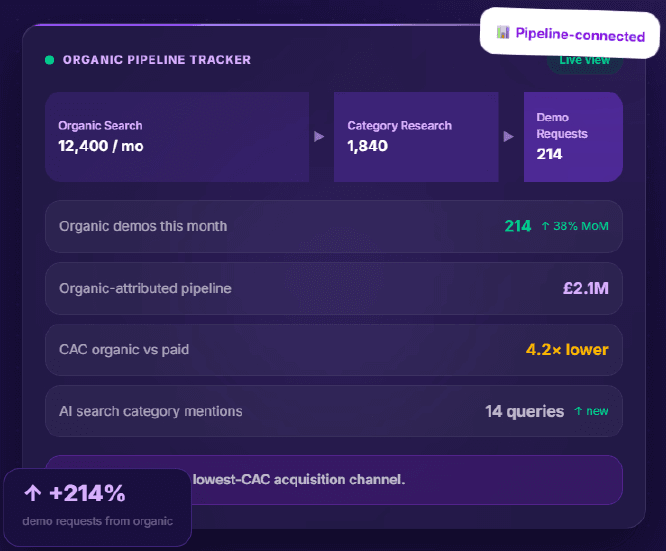
Your analytics say organic brings traffic. Your CRM says demos come from 'direct.' No one knows which organic content is actually driving pipeline - so you can't invest more in what's working or cut what isn't.
increase in demo requests for Series B SaaS client after 11 months
organic pipeline influenced in a single SaaS engagement
lower customer acquisition cost from organic vs paid for SaaS clients
of all demo requests now from organic -up from near zero
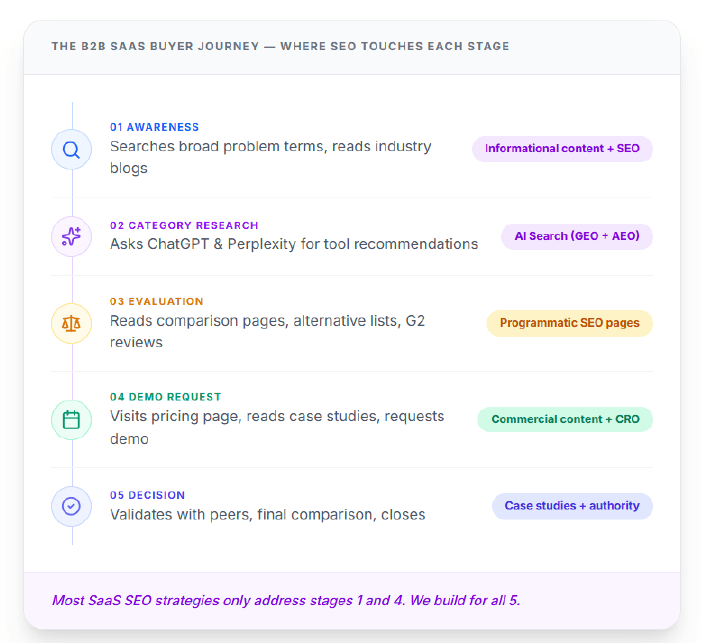
The standard SEO playbook is built around transactional keywords and volume. B2B SaaS buyers research across 4-8 touchpoints before requesting a demo – and most of those touchpoints have nothing to do with your highest-volume keywords. Your SEO strategy needs to match how they actually buy.
“A Series B project management SaaS had 0 organic demos. Not a few-zero. Their agency was sending monthly traffic reports showing growth. Nobody had connected sessions to demo conversions. After a technical SEO audit, programmatic integration pages, and an Al search strategy organic became their lowest-CAC acquisition channel within the year.”

Tools crawl and surface data. We interpret it. Every issue in a tool export carries the same visual weight — a missing meta description sits next to an indexation disaster. Our audit layers specialist judgment over the raw data: we identify root causes, cross-reference findings across dimensions (why is that page not indexed? Is it robots.txt, a noindex tag, a canonical conflict, or something else?), and produce an output ranked by business impact. The result is a fix plan your developer can sprint on — not a spreadsheet with 3,000 rows and no priorities.
A focused technical SEO audit typically takes 5–8 business days from access and data provision to final delivery. The Full-Stack Clarity Audit (which covers technical, content, authority, AI search, and analytics) takes 10–15 business days. We never rush the diagnosis — the quality of the fix plan depends entirely on the depth and accuracy of the analysis that precedes it.
It depends on the type of fix. Indexation issues — once resolved — can show ranking improvements within 4–6 weeks as Google re-crawls and re-evaluates the affected pages. Core Web Vitals improvements are typically reflected in rankings within 8–12 weeks. Site architecture changes take longer, sometimes 3–6 months, as Google re-evaluates your crawl structure. We give honest timelines for each finding in your Clarity Report — not generic estimates.
Yes — and we'll tell you this upfront. Technical SEO findings require implementation, and implementation requires a developer (or a CMS with sufficient flexibility). Our fix specifications are written to be as developer-friendly as possible — specific, unambiguous, and prioritised by sprint. If you don't currently have developer resource, we'd recommend our SEO Strategy & Consulting service as a starting point, which focuses on what can be improved without engineering dependencies.
The audit is a diagnostic product — we deliver the findings, the priorities, and the specifications. Implementation is your development team's work, supported by our specifications. However, for clients who proceed to an ongoing SEO retainer after the audit, we provide QA review of implemented fixes, monitor their impact in Search Console, and adjust priorities as the picture changes. We don't do web development, but we do stay accountable for outcomes.