
Your site looks fine. It might even feel fine. But somewhere between crawl budget, broken redirects, and pages Google can’t properly read, you’re losing rankings you should have. We find exactly where and hand you a fix plan a developer can start on Monday.
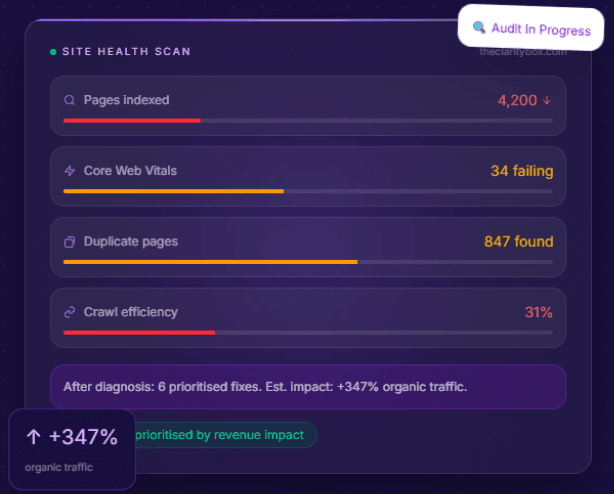
No error messages. No warnings. Just rankings that quietly stay flat while competitors with worse content outrank you.
Crawl budget wasted on pages that don't matter, while the pages that actually make you money sit unindexed or buried three clicks deep.
Duplicate content, broken canonical tags, and conflicting redirects tell Google your own pages are competing against each other.
Core Web Vitals aren't a checkbox they're a ranking factor. A slow product page can outrank nobody, no matter how good the content is.
Internal links built with no strategy mean your strongest pages aren't passing any of their authority to the pages that need it.
of sites we audit have critical blockers the team didn't know about
weeks for ranking Improvements after high-priority fixes go live
crawl budget efficiency gained after architecture diagnosis
organic traffic growth -Series A SaaS after technical audit alone
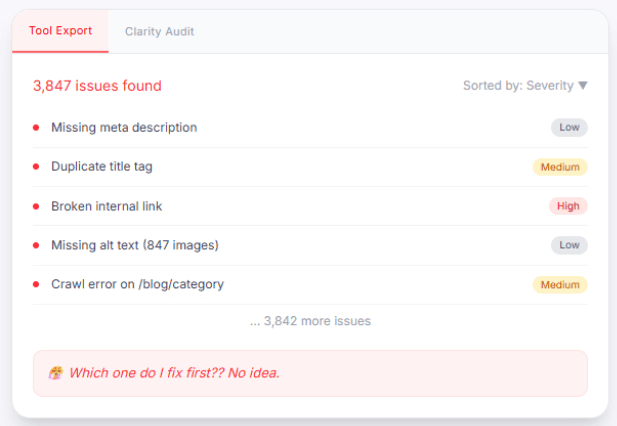
Anyone can run Screaming Frog and hand you a spreadsheet. That’s not an audit it’s a data dump with your name on it. We run the tools, then do the part that actually matters: figuring out which of those 400 flagged issues are costing you rankings, and which ones nobody needs to touch.
Search engines can’t rank what they can’t find. We audit how Googlebot actually moves through your site — where it’s wasting time, where it’s getting blocked, and which important pages aren’t indexed at all. What we check:
Every internal link either passes authority to a page or wastes it. We map your site’s structure and fix the links that are quietly starving your most important pages of the ranking power they need. What we check:
Speed isn’t a nice-to-have it’s a ranking factor Google measures directly. We diagnose exactly what’s slowing your pages down, by template, so fixes target the pages actually losing you rankings. What we check:
Structured data is how you tell search engines exactly what a page is a product, a review, an article, an FAQ. Missing or broken schema means you’re relying on Google to guess, and it often guesses wrong. What we check:
The infrastructure layer most audits skip mobile rendering, HTTPS setup, redirect chains, and server response issues that quietly undermine everything else you fix. What we check:




Almost always - but with an important caveat. Technical issues are usually the ceiling on how far your rankings can go. Fixing them removes the ceiling; it doesn't automatically propel you to position 1. You'll also need strong content and authority. That said, when technical problems are the primary blocker - which they are on roughly 60% of sites we audit-fixing them produces the fastest visible ranking improvements of any SEO work.
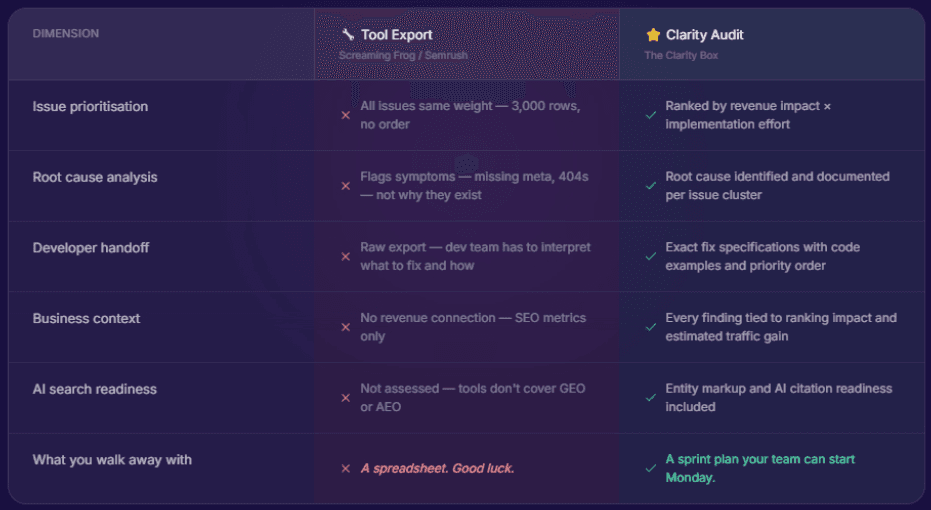
Tools crawl and surface data. We interpret it. Every issue in a tool export carries the same visual weight — a missing meta description sits next to an indexation disaster. Our audit layers specialist judgment over the raw data: we identify root causes, cross-reference findings across dimensions (why is that page not indexed? Is it robots.txt, a noindex tag, a canonical conflict, or something else?), and produce an output ranked by business impact. The result is a fix plan your developer can sprint on — not a spreadsheet with 3,000 rows and no priorities.
A focused technical SEO audit typically takes 5–8 business days from access and data provision to final delivery. The Full-Stack Clarity Audit (which covers technical, content, authority, AI search, and analytics) takes 10–15 business days. We never rush the diagnosis — the quality of the fix plan depends entirely on the depth and accuracy of the analysis that precedes it.
It depends on the type of fix. Indexation issues — once resolved — can show ranking improvements within 4–6 weeks as Google re-crawls and re-evaluates the affected pages. Core Web Vitals improvements are typically reflected in rankings within 8–12 weeks. Site architecture changes take longer, sometimes 3–6 months, as Google re-evaluates your crawl structure. We give honest timelines for each finding in your Clarity Report — not generic estimates.
Yes — and we'll tell you this upfront. Technical SEO findings require implementation, and implementation requires a developer (or a CMS with sufficient flexibility). Our fix specifications are written to be as developer-friendly as possible — specific, unambiguous, and prioritised by sprint. If you don't currently have developer resource, we'd recommend our SEO Strategy & Consulting service as a starting point, which focuses on what can be improved without engineering dependencies.
The audit is a diagnostic product — we deliver the findings, the priorities, and the specifications. Implementation is your development team's work, supported by our specifications. However, for clients who proceed to an ongoing SEO retainer after the audit, we provide QA review of implemented fixes, monitor their impact in Search Console, and adjust priorities as the picture changes. We don't do web development, but we do stay accountable for outcomes.